They've been coming to our house over the last three years. Jon taught them as freshmen (well, some of them anyway) and now these Xavier students make the pilgrimage up the 75 every couple of months during the school year. The group evolves depending on friendships, who's dating, whether they can find someone with a car.
Last night three of the old regulars showed up with two newbies. The house is so quiet right before they arrive. Then as one big blast of energy from the cold outdoors, they tumble into our entryway, flinging off thick coats, hugging me, Jon, each of our kids, all talking at once, smiling, laughing.
We move into the kitchen and right away, the regulars notice the new table! and the rearrangement of furniture! and the X-Box Rock Band game! The newbies dive into the snacks waiting for them.
As happens, various conversations break out like sparks flying from a bonfire. Mark and I stray into the family room to flip through Maurice, by E. M. Forster. We're fans; Mark wants to share the moving passage where Maurice "comes out" because he knows I'll like it, too. We digress to politics, Mark justifying his support for Hillary while I talk about Obama. I'm always impressed with the political awareness of this group of students. They read, they care, they make good judgments.
Meanwhile at the table, despite the snacks, hunger breaks out.
I make lots of food when the kids come. Last night: lasagna, salad and garlic bread; followed by key lime and apple pies. We joke with Scarlet who can eat the boys under the table yet is skinny as a rail! Mark is a vegetarian so I make him a separate mini-lasagna, only to discover that Jordan had "gone veggie" in the last week, too. They split it.
Jordan helps me serve in the kitchen while we discuss theology: it's his major. He tells me that his goal is to reform our understanding of Christianity. I tell him I hope he does!
After dinner, we move into the living room for the real objective of the night: Catch Phrase. Jon starts his college classes on the first day with Catch Phrase to loosen up the students, to give everyone a chance to play, to talk, to risk, to get to know each other. Catch Phrase at our house, however, is for one purpose only: to get even!
It's a blood sport in our living room.
We sit alternating to ensure the proper teams as these have become inflexible over the years. We add and substitute the newbies for those who can't come or have moved away. But the core players remain the same which means that Mark, Jon and I are on one team while Jordan, Scarlet and (usually) Jacob are on the other. Jacob was gone last night so he was replaced by the very competent roommate of Scarlet. To round out the teams, Liam played with us and a new student, Iman, played on Team Two.
Still, I'm usually somehow on the losing team. Which means Jon is on the losing team. Which means Mark is on the losing team. And. That. Is. Unacceptable!
We adjust our chairs, we make sure we can jump up and high five without knocking over candles or picture frames. We are ready.
The electronic device whirls around the circle:
It's a dance. A dance like in the 70's... A movie called blank "Nights"
Boogie?
Yes. Then there's a word that's not a word that goes with it.
Boogie Disco, Boogieman, Boogie-woogie?
Yes!
Fling... and the device flies at Mark as it buzzes, while Mark throws up his hands as if to say "I don't have it. It's not in my hands."
Immediately all hell breaks loose:
I threw it to him, but he wouldn't catch it.
It was buzzing before it got anywhere near me.
Shouts, re-enactments, outrage... Over the bedlam, the voice of reason (and impartiality) in an eleven year old body shushes both teams: "It's a 'do-over'."
And we all know, instinctively: we can't challenge Caitrin.
So the night goes - words flying, laughter, dubious hand-offs resulting in more play-by-play reviews than at the Super Bowl.
Yet at night's end, when all is said and tossed, the best team wins two out of three. Yeah, you know how we do.
In a fervor of rehashing the plays, everyone decamps to the kitchen for pie. In solidarity with the events of the night, my crazy whipped cream dispenser loses control and sprays the entire room (hair, t-shirts, table, floor and dog's tongue) to the delicious laughter of everyone.
Then as the night winds down, Jon and his current students discuss how to make his class better. He asks their opinions, listens, makes adjustments, hears their critiques. It's remarkable, really, to see students so comfortable expressing their thoughts to their professor, the man who holds the keys to their grades. Perhaps just as amazing is that he welcomes their viewpoints.
Finally, it's nearly midnight and time for them to go home. With less energy now, they stuff their arms back into bulky coat sleeves, shuffling to the door. Even the newbies get good-bye hugs. We all promise to do it again soon.
Showing posts with label Xavier University. Show all posts
Showing posts with label Xavier University. Show all posts
Saturday, February 09, 2008


Thursday, November 15, 2007
De-centering the self: Michael Dyson
 One of my favorite pomo expressions is: de-centering the self. It's one I've spent a lot of time contemplating. Most of us live in our own bubbles of comfort, culture and "correct" thinking. We interpret the world through the lens given to us by our parents, our race, our socio-economic backgrounds, our Englishes, our educations, our faith traditions (or lack of them), our gender, our topo-geographic localities, our relationships, our pains, our abuses, our joys... all of these wrapped together create us, shape how we understand the world and each other. As we become competent in our worlds, we gain speed at navigating the requirements (passing tests, earning degrees, getting jobs, managing money, initiating relationships, respecting the tax laws, obeying the rules of the road, shopping, dressing up and down and when, showing respect and disrespect including knowing when and how to do each, having sex, managing the level of technology your world affords and/or requires... and so on).
One of the reasons going to a foreign country is so often recommended as an "expanding" experience is that in deliberately leaving behind what we know, we are suddenly de-centered. The way we know the world is no longer "normative" but in many cases, an impediment to successful living. For instance, my history degree didn't help me bake bread or wash my clothes by hand in Morocco. I was seen as a flawed married woman without the necessary skills, not as a highly educated "prepared for adult life" individual.
What I took for granted (knowing the price of postage, counting change, finding a store open at hours you expect, locating the bus line, weighing vegetables, lighting a stove, hooking up a telephone, daylight hours, flavors, words, etiquette, smells, the shapes of buildings, toilet flushes) suddenly cost me energy. All day long I was bombarded by ineptitude... my own.
It's not uncommon to need naps when you move to a new country. It's also perfectly normal to develop irrational fears and judgments: What if I get lost downtown? How will I find the right bus? Why does that man look me in the eye? Didn't she just snub me? Why do they do it like *that* when it would be so much easier to do it like *this*?
The advice to people who face culture shock (or culture stress, as it is more commonly called now) is to let go of the old expectations. The quicker someone immerses self into this new reality, the faster she becomes happy. The more language a person has, the more fluency in all aspects of foreign living. Over time, the expatriate not only learns that there are other ways to successfully live on the planet, in some cases, the new ways become prized as more valuable than the formerly most comfortable ways.
What is really remarkable about living abroad is that you have no option but to recognize that your way is not the only way. Hearing about a foreign way of life is no approximation for how it actually feels to live it. When your senses are overwhelmed, you are obligated to either have a breakdown or figure it out. You must yield to the reality that there are multiple ways to live that give people the things we all crave: love, belonging and competence.
Last night, Jon and I attended a lecture given by Dr. Michael Dyson. We've heard him before. He's what is known as a "public intellectual, teacher and cultural critic." Dyson speaks from his personal space of being black, of interpreting and representing what are black issues today and he does so in an almost Robin Williams-esque style (freely flying between ebonics, black speak, white speak, intellectual-ese and rap).
We arrived at Xavier about five minutes before the start of the lecture. The hall was already filled with audience members... virtually all black. It hit me. I'm used to Xavier being white with a smattering of other ethnicities. Yet last night, Jon and I found two seats smooshed in the middle of the hall surrounded by blacks. I was not troubled. I was aware. This must be how it feels all the time in the suburbs for blacks. When a black family joins our homeschooling co-op, they know that their kids' friends will all be white, that they will be the only blacks in the room much of the time.
Last night, I felt it. Not just that I was white-skinned, but culturally white. When Dyson would talk about the way their "mammas and daddies" raised them, he talked about teaching kids that they have to rise up and overcome obstacles. He talked about two languages: the ebonics of the home and the standard English of the outside world. He quoted Marvin Gaye and the Temptations and found the audience finishing his sentences. He rapped like Jay-Z and the college kids rapped with him. Jon and I laughed our heads off with the crowd, but we were not a part of it. We had entered that other world where the assumptions I have mean little to the gathered.
It was a lot like visiting a foreign country.... only different in one important way. When I go abroad, I'm deliberately choosing to place myself in the mode of "learner." I know I will not "know" how to be, do, talk, live. I choose to be open to learning. When I'm in my country, I don't want that experience thrust on me. I expect to feel competent, at ease. Last night, I was reminded again of how important it is to deliberately seek to be out of my comfort zone, to listen to the points of view of those who even see me as a threat, an enemy or an impediment to their competence and success in the larger culture. In other words, I realized that for blacks, they spend a lot more energy than I do accommodating the largely white culture I come from... every day. I dipped into it for about three hours one night.
I don't know how else we ever get to that place where we know and honor each other's experiences unless we de-center the self regularly: like jogging, like eating right, like holding back bad words, like de-cluttering the house, like taking medicine or vitamins. Self-discipline to give up my right to be comfortable and right.
Sunday, May 20, 2007
Like auntie, like niece
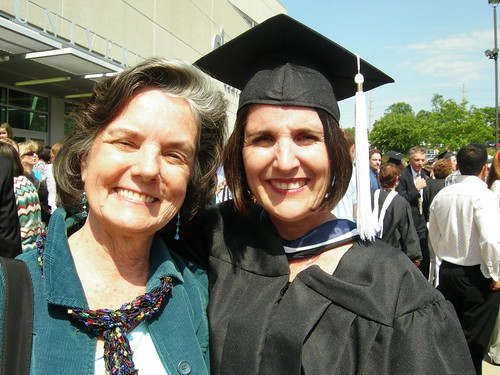
For those who are diehard Julie Unplugged voyeurs, my entire graduation set can be viewed here. Warning: there are 42 pictures and I'm in every one. Ack! :)
What an extraordinary day! My aunt and uncle flew in from California on Friday night. My aunt was in the car for five minutes and immediately we were deeply involved in conversation about the nature of the testimonial genre in theology, particularly as it relates to torture (Diana Ortiz was the focus of this conversation). June (my aunt) is a tireless thinker, a deeply affirming person and thoroughly enjoyable company. We never stopped talking the whole weekend.
One of the things I keep thinking about at the end of this journey is not what I believe but rather how I think theologically. On the way to the airport today, June and I discussed the fact that part of the postmodern condition is that once we've deconstructed faith, truth, reality, we are faced with a table of puzzle pieces that won't neatly fit back together. Somehow extra pieces get into the box and refuse to torque themselves into the right shape to complete the picture.
So must we account for every piece when we put our theology back together? In other words, when we are thinking theologically, just how many experiences, ideas, doctrines, traditions must we account for, include, reconcile?
There is no definitive answer to this question obviously, but I did find myself automatically seeking principles for that process. I do consider it vitally important not to ignore the misfits in our theological puzzles. We want to. We hate that some of those ideas and experiences mess up our neat, tight, well-structured theologies. We want to have an organized system of beliefs that is one size fits all.
Yet if we leave out (deliberately or naively) the schools of thought, experiences, and worldviews that clash with the one we want to protect, we will arrive at a theology that doesn't ring true. It will feel protective and rigid, rather than expansive and enveloping. It's not enough to toss the misfit pieces into the mystery box and ignore them. For instance, when someone claims that God abandoned her during torture and did not experience comfort, companionship, succor or hope, we can't simply throw blame back on the victim for not appropriating God's presence, nor can we ignore that important testimony about the direct subjective experience that negates the belief that "God is there for us when we suffer."
Both the ones who find God "there" for them in suffering and the ones who do not must be accounted for in some meaningful way or our theology is a fantasy - it's the gratification of our dearest hopes, not the expression of an attempt to make sense or meaning out of life and faith.
How do you account for the complexities of experience when describing or narrating the faith? I'd be interested.
Friday, May 11, 2007
Celebratory marscapone

Jon and I went out to dinner to celebrate. And then I remembered all the things I had discussed at the defense that I forgot to include in today's post. I hope to catch up with some other thoughts over the weekend and in the UPI column for Monday.
Thanks to everyone for such warm, congratulatory comments. Today felt like one of those rare days where the light was brighter and life looked more important. You were a part of that, so thanks.
Master's in Theology, Xavier University, May 2007
 This is an extremely long entry. I'm writing it for myself as a record of the day, but am happy to share it with those who are interested.
I couldn't shake my nerves yesterday. I got up early and re-read (in skimming fashion) the entire book Letters and Papers from Prison making notes, listing page numbers with quotes, reminding myself of things I had forgotten or hadn't thought about recently. (Bonhoeffer's view of women sure needed some reformation! More on that another time...) I walked around the house agitated, like a pacing cat. I bought nail polish and then didn't put it on my nails. I showered and dressed in my nice outfit, and then emptied and loaded the dishwasher. I ate nothing and didn't even make food for the kids.
At 1:15, I left for school--paid too much for gas, got the car washed and drove. Do you remember my post two entries ago? It was titled "The end of the world as I know it..." Would you believe that the first song on the radio yesterday afternoon on the way to Xavier was "The End of the World as We Know It." I haven't heard that song on the radio for years. It was followed by Rob Thomas's "Little Wonders." Very appropriate...
our lives are madeI can't put the time back in the bottle. It keeps spilling out no matter how present and conscious I am in each moment.
in these small hours
these little wonders,
these twists & turns of fate
time falls away,
but these small hours,
these small hours still remain
I arrived at school to see moms and dads emptying dormitories of computers, book shelves and oscillating fans. Undergrads, in sweats and smiles, hauled bags of dirty clothes to their parents' cars--the end of a school year and finals.
I clicked in my heels up the brick walkway. I purchased three thank you cards for my advising team and a bottle of water. Once I'd written pithy notes (my writing is horrible when I'm nervous - nothing original or fresh or specific.... just gushes of gratitude), I made my way to the conference room in Hinkle Hall. I was the first to enter that room.
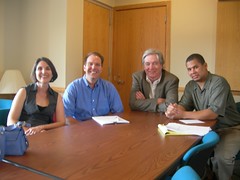
Two minutes later, my chief advisor (Dr. Walker Gollar) arrived with a big smile and a handshake. My stomach rolled. Then Dr. Adam Clark (my black theology professor) joined us, followed a few minutes later by Dr. Art Dewey (Pauline Writings - very first class, Foundations of Biblical Studies and New Testament Greek). We all sat at this long conference table with the floor to ceiling windows for all passers-by right across from me.
They began by each one affirming how much they enjoyed my paper and how provocative it was. That felt good.
Then it was up to me to begin with context so I did. I shared what they mostly already knew, but I filled in a few blanks. I gave fuller expression to what drove me to grad school, why Bonhoeffer has been a consistently useful theologian in my studies and how grad school had helped me to make comparisons and to analyze Bonhoeffer's content in a way I hadn't achieved on my own. (It is amazing to me how every time I open the letters and papers, I discover that something I had not noticed or understood before becomes immediately apparent and clear now that I've read so many more of the writers that influenced him or understand the references he makes.)
Once I concluded my little intro (less than five minutes), Dr. Dewey went first. I knew to brace myself for the hardest questions from him. He's creative and insightful. He challenged right out of the gate the use of performance theory to describe Bonhoeffer's appeal. So we spent several minutes discussing the nuances I meant to emphasize versus the insight he brought to the table: doesn't performance also indicate the use of masks or roles? Is it possible that in writing letters (even if they were not intended to be published) that Bonhoeffer was constructing a role, constructing a fiction just as much as if he had written a book (Dewey was critiquing what he thought was my attempt to call this kind of writing more authentic than another form)? (For those confused by this language, let me explain it like this - all of us are constructing roles and fictions all the time... that's how we create and form our identities and relationships.) So his challenge to me was to ask me whether or not I was simply expressing a preference or if I was rating one way of constructing self as more genuine than another.
My response to this was that I wasn't judging authenticity as much as I was crediting Bonhoeffer's legacy as being more compelling because of his letter writing and the way his performance (life) matched his rhetoric so openly. We discussed for several minutes. It went well.
Then Dr. Dewey asked me to examine and critique Bonhoeffer's christology. He put it like this: "How would you tutor Bonhoeffer today, based on the developments in christology since he wrote his letters and papers?" We looked at a passage in his letters where Bonhoeffer asks Eberhard Bethge (his primary dialog partner) how the Gospel writers could have known what Jesus prayed in the garden before his crucifixion. Bonhoeffer remarks that it just doesn't make sense that he told it to the disciples at some later date after the resurrection. So I explained that Bonhoeffer hadn't yet delved into the study of the historical Jesus and was more interested in reinterpreting orthodoxy than he was in re-examining its core doctrines. For instance, he clearly grasps that the creeds can be used to demand beliefs that people don't actually believe and he finds that to be a wrong use of the creeds. Yet he never goes so far as to explore what might be the alternative. He is more willing to leave it to mystery. He does state that while he has been influenced for the good by liberal theology, he is attempting to retain orthodoxy in some relevant way. But he suspects that men (sic) after him may have more success than he has had in addressing this difficulty.
Additionally, we looked at his use of language and beliefs that rely on assumptions that have been challenged since the 1940s, such as Christ as the center of reality (how does that fit with other world religions?), death and resurrection (what do they accomplish - personal salvation or kingdom of God justice or both or something else?). Dr. Clark picked up on this theme later when he asked where the phrase "Jesus, the Man for Others" came from. None of us know. But what I do know is that Jesus as the man for others is about the crucifixion, not about the kingdom of God (in Bonhoeffer's construction). So we discussed these issues several times over the course of the hour+.)
From here, we moved to Dr. Clark. He challenged my use of postmodernism as a lens through which to view Bonhoeffer. (So do you get what's happening here? The two primary planks of my paper were gutted in the first 17 minutes of discussion! And it was okay - in fact, it was amazing.) We discussed postmodernism at length. I gave my point of view that while I would never categorize Bonhoeffer as a postmodernist, I would say that Bonhoeffer was having a postmodern-style crisis of faith. The war pushed him to go places theologically he would never have gone without it. As a result, this aristocratic, huge brained, intellectual, German faced the conditions of oppression, abuse of power, the clash of out of date cosmology against modern cosmology, and spent most of his time in prison deconstructing his faith and country.
In fact, one of the fresh insights that I don't think I drove home in my paper yet came to me as we dialogued is that Bonhoeffer's view of the human person was radically altered through his prison tenure. He moved away from a strictly Lutheran perspective (as Dr. Clark quoted Luther or Calvin: humans as "snow-covered dung") and instead, saw human beings in all their fallenness as strong, valuable, capable of making a real difference, even good. He sees human life as of the utmost signficance (more than the afterlife). What grounds his view of the human person, though, is that he is utterly confident in God's forgiveness for when he fails (which retains that Lutheran view of the atonement). In this sense, he has created the ideal conditions of risk. It's not that we are free to sin, it's that we are free to risk sinning on behalf of others. That's the insight.
Therefore as we explored further, it became apparent that Bonhoeffer's primary message in his religionless Christianity is that risk is an essential quality of Christian practice and faith. Without risk, one has ceased to be a genuine Christian.
I know you're ahead of me: what is risk for a middle class, suburban mom of five? Yep. That's just where they went! I blinked twice. "I have no idea." They all chuckled appreciatively. So we discussed then this dichotomy of the call to risk and the lack of correspondence between our ideals and our lives. I did express that for my current years as a student of theology, risk has looked like consistently putting out my ideas for exposure and dissection to people who don't approve of them. It's cost me business and friendships. It is the primary way I have risked, though it is certainly nothing compared to risking one's life on behalf of others.
I was asked whether or not I thought Bonhoeffer should have participated in the plot to kill Hitler. I honestly don't know. I answered that I'm more interested in the theological gymnastics that that commitment prompted, yet I also feel without being in a similar condition, my judgments would not be worth much. We discussed MLK Jr. (who was also assassinated at 39) and wondered if he would have remained strictly pacifist. I compared Bonhoeffer's journey to MLK Jr. in the early years and then radicalized into a Malcolm X by the time of his death. Then Dr. Dewey asked: "Do you think Jesus would have killed Hitler?" That really put it to me!
I said, "No." Then we discussed all the ways that Jesus was subversive in his time, but that he didn't organize for the purpose of overthrow. Dr. Gollar interrupted with Just War theory and asked why that didn't apply to Bonhoeffer. I suggested that the allied forces were already engaged in the war at that point and that Bonhoeffer was a part of an internal resistance which I wasn't sure worked in JW theory. I gave a lot of "But I don't want to say definitively..." kinds of answers. Then Clark came back with Ghandi saying that Ghandi believed in non-violence, but he believed more in courage. He suggested that Ghandi would rather see someone throw a punch to resist evil than to stand back while evil is done in the name of the "principle" of non-violence.
Wow! That one really struck a nerve for me. This is just what Bonhoeffer did. He threw off his principles for the sake of courageously throwing a punch at evil when he was supposed to be cowed into submission by the Third Reich. (There's a whole section at the front of the book where Bonhoeffer's correspondence with the interrogators shows him defending himself against accusations, stating emphatically that he is telling the truth, followed by letters to his friend where he discusses a theology of lying, secrecy and truth-telling.)
Dr. Dewey then wondered aloud how significant a role DBH even played in the attempt on Hitler's life since he was in prison when it occurred. Very many overlapping issues.
We also addressed the conventionality of Bonhoeffer's basic outlook on gender roles, the role of the government and his relationship to his nationality. I asserted that in most ways, he was conventional. Yet his creative mind and his deep commitment to living a practical life of action (harnessed to sound theological thinking) made it possible for him to resist the temptation to defend the status quo. If you think about it, that is the more radical of the two anyway. Unconventional people are often moved to risky action. It is the conventional who are usually not.
Dr. Gollar's turn came and he addressed Bonhoeffer's relationship with his fiance. He asked me how the tenor of the letters changed when he wrote to Maria. It was a surprising, yet terrific question. I had just that morning reread in one letter to his friend Eberhard where Bonhoeffer openly criticizes Maria's taste in books. He goes on and on about how the books she reads are beneath her and how he can't stand when husband and wife don't agree on everything. He is set to reform her and then wonders "Or is this just my tyrannical nature coming out?". We all chuckled over that. Maria was more fantasy than real relationship. They had spent a total of one hour together alone before his prison tenure began. They barely knew each other. She was just 18 and not an intellectual. She served, in the end, as a catalyst for his reflections on the meaningfulness of human emotion, physical needs and the value of life. So his letters to her had more to do with his longings (physical especially) than with his theological process.
By the end of his letters (where he began with such appreciation for his books, a parcel of laundry, his cigarettes, his connections to the outside world), Bonhoeffer was reduced to one thing: human relationships. He instructs his mother to give everything he owns away and tells her that all that remains for him are his relationships. It is a poignant end to his two years in prison.
At this point, I was asked to leave the room. They spent about eight minutes discussing the session. When Dr. Gollar came to get me, he beamed, "They loved it. They loved the whole conversation."
I returned and they immediately were on their feet shaking my hand, congratulating me, smiling, telling me what a great job I had done and how much they enjoyed the whole discussion and paper. I handed out the thank you cards. Then they gave feedback. Dr. Dewey suggested that the paper could be stronger without the performance analysis and Dr. Clark suggested I take out the postmodern language and gave me instead, some other ways to frame that part of the paper. Dr. Gollar then brought up how I had revitalized Bonhoeffer for all of them. Drs. Clark and Dewey talked about ways they might incorporate Bonhoeffer into fall courses! (I gave my schpiel on how they ought to do that since I've thought lots about it. [g]). Not one course in my years at X has included anything by Bonhoeffer so that made me really happy.
Then we got up to leave and left the room, but stood in the hallway discussing cults, sex, conservative and liberal theology, feminism, and parenting. After 30 minutes, we split up (I left with Dr. Clark in the elevator). He and I talked for twenty more minutes about the youth retreat he is leading at his church this summer and how to address teen sexuality. Then Dr. Dewey came downstairs and joined us for ten more minutes. Then Dr. Gollar came downstairs and we all laughed that we couldn't stop talking.
Finally, FINALLY it was over. I hugged everyone, fought back tears, and walked into the sunshine with my heels click, click, clicking over the bricks to my car, reliving the experience and already missing grad school.
Wednesday, May 09, 2007
End of the world as I know it....
After four years, I have completed all the coursework for my MA. I turned in my last final, said good-bye to my professor and classmates.
Tomorrow at 2:30, I'll defend my thesis. I'm wrung out from writing, thinking, shopping (have to have the right chic defense blouse to wear... after all, my committee is three men!). I need to write a few crib notes to be sure I don't forget the chronology of Bonhoeffer's books. It's weird how much anxiety I feel even though I'm also really looking forward to it.
So no more energy to write here, but promise a full report of tomorrow's outing once I have finished.
Thanks for all the support along the way.
Tomorrow at 2:30, I'll defend my thesis. I'm wrung out from writing, thinking, shopping (have to have the right chic defense blouse to wear... after all, my committee is three men!). I need to write a few crib notes to be sure I don't forget the chronology of Bonhoeffer's books. It's weird how much anxiety I feel even though I'm also really looking forward to it.
So no more energy to write here, but promise a full report of tomorrow's outing once I have finished.
Thanks for all the support along the way.
Tuesday, May 01, 2007
My theologically inclined aunt is...
coming for my graduation!
For those who don't know, my aunt is a professor of religion at University of California, Riverside. She began her adult life as a nun, then earned her Ph.D. in religious ethics, and then fell in love with a priest [big grin]. They came out of their orders and got married. There's a much longer, very admirable story to go with all this. They didn't just abandon their vocations. Much thought, love, and prayer went into all of their decisions. The result, of course, has been that the two of them are among the most active, community-contributing people I've ever met. And my aunt's theological mind is brilliant.
My Aunt June (my mother's sister) has been a huge source of inspiration all these years as a Christian, but particularly as I've deconstructed faith and entered graduate school. She is one of the most clear-headed thinkers I know and has even had the generosity of spirit to read my lengthy papers and engage me when I needed help in thinking through a theological conundrum. I discovered early on: Nothing I could ask or question would shock her. What a nice thing that is to have someone in your life who can hear what you say, and then, can also intelligently engage it with insight, charity and provocative rejoinders.
Basically, she's awesome. :) I'm thrilled that she will be here to celebrate with me. Feels so fitting.
And last thing. I know you've all already congratulated me on the various stages of the thesis. No need to add any more comments of that nature, but I thought you should know: The thesis has been accepted and received an outstanding review from my advisor. I am scheduled for the defense in two weeks. All I have left now is a final paper for Doctrine 1, due a week from tomorrow.
May 19 (graduation day) is right around the corner.
Cheers!
For those who don't know, my aunt is a professor of religion at University of California, Riverside. She began her adult life as a nun, then earned her Ph.D. in religious ethics, and then fell in love with a priest [big grin]. They came out of their orders and got married. There's a much longer, very admirable story to go with all this. They didn't just abandon their vocations. Much thought, love, and prayer went into all of their decisions. The result, of course, has been that the two of them are among the most active, community-contributing people I've ever met. And my aunt's theological mind is brilliant.
My Aunt June (my mother's sister) has been a huge source of inspiration all these years as a Christian, but particularly as I've deconstructed faith and entered graduate school. She is one of the most clear-headed thinkers I know and has even had the generosity of spirit to read my lengthy papers and engage me when I needed help in thinking through a theological conundrum. I discovered early on: Nothing I could ask or question would shock her. What a nice thing that is to have someone in your life who can hear what you say, and then, can also intelligently engage it with insight, charity and provocative rejoinders.
Basically, she's awesome. :) I'm thrilled that she will be here to celebrate with me. Feels so fitting.
And last thing. I know you've all already congratulated me on the various stages of the thesis. No need to add any more comments of that nature, but I thought you should know: The thesis has been accepted and received an outstanding review from my advisor. I am scheduled for the defense in two weeks. All I have left now is a final paper for Doctrine 1, due a week from tomorrow.
May 19 (graduation day) is right around the corner.
Cheers!
Thursday, April 26, 2007
Wednesday, April 25, 2007
Authenticity comes at a high price
That's what one of my online friends said this week. I keep thinking it over.
What is authenticity really? How do I know when I'm being authentic? I've been a person who takes the time to think through what I believe (whether it has to do with faith, birth, schooling, parenting, politics, computers (Macs, of course)). But that doesn't always mean that I've come to an authentic place when I draw my conclusions. So many mitigating forces compete unbeknownst to me. I'm sure now that much of the appeal of Campus Crusade in college, for instance, is that it ensured me a pool of "moral males" from which to find a husband - hopefully a bunch of guys who would agree that you should marry once, for life, and not fool around. My parents' divorce had a powerful impact on me at that time in my life, and yet if you had asked me then, I would have said that I was making choices based on discovering the truth. And I believed that to be the case at the time.
Then there were those decisions like missions, not using birth control and letting God choose the size of our family, not circumsizing our boys (only to find out that my uncircumsized Dad in his 60s has had all kinds of problems that led to a circumcision at that late age! Ouch!), participation in Operation Rescue, joining the charismatic/prophetic movement, homeschooling, and more that felt so right at the time, yet on review, look like they were an expression of that need to commit to the hilt, to join with those who put "right" ahead of "feelings." What a potent frame that need to be right was. It was a kind of protection against the swirling chaos of choice, self-knowledge and the dangers of someone else undermining my aspirations with their flakiness. If I could conclude what was right, I didn't have to consult feelings, finances, fears or faith. I could just do what was right and I'd be right too.
I don't regret all these decisions, btw. For instance, I have never regretted homeschooling. It is a happy accident that has turned out to be something I still believe in even after all the other religious cant was deconstructed and looked at newly.
I felt I was being genuine in each place, though, and I thought I was taking in all the considerations when I made these choices. I believed I was being "authentic." Perhaps I was at the time, given the limits of my knowledge, the invisibility of my emotional crisis as an adult child of divorce, and my rigid Christian belief system. I can see at work these silent partners: drive for community, rejection of family of origin's values, the need to make a difference, putting my "convictions" ahead of my emotions or doubts, dichotomistic thinking...
I remember being in my first graduate course nearly four years ago. The professor gave a lecture that discussed the radical nature of the vision Paul casts in his letters, how it has often been misused as an endorsement of the status quo rather than an overhaul of it. He made mention of how Christianity was a challenge to empire, that it was meant to cut to the heart of the culture and style of governing. As he built his case, I raised my hand and told him what I thought he didn't know: that evangelicals and fundamentalists felt the same way today - that they were wanting to use their faith to change the culture, to overthrow a secular style of governing and turn it toward Christ.
My professor countered: "I would contend that today's Christians want to preserve the status quo at the deepest levels. They are not about challenging it, but about preserving it, protecting and warding off challengers. They are the essence of empire and not the essence of what Paul or Jesus were about."
I had no idea what he was talking about. I remember being so frustrated that he hadn't heard my point, didn't understand just how much my community believed itself to be radical, changing the course of the country and bringing faith to a godless nation, etc. Yet even as I thought it, I knew my own mind limited me. I couldn't quite see my thinking, I could only see the results of my thoughts.
As we left class, I caught up with Dr. Dewey and asked him with anxiety: "How do you learn to observe your own thinking, to see the way you form ideas and thoughts? I feel trapped by my own brain. I sense there is a way to see my thinking so that I recognize the traps I lay for myself, the ways I skew information to fit a pattern. But right now, I can't see it. I don't know how to get there. I know you are talking about things that mean something other than the meaning I am making from them. But I can't see what it is." I was a bit desperate.
He replied, "Julie, patience. You'll get there. It takes time and you are just beginning that process now."
That wasn't the answer I wanted, but it was the right answer. For four years, I've been learning more about the way I process information than anything else. I find myself stopping mid-read of an article aware of my knee-jerk reactions, conscious of how I might have interpreted something before, aware of the influences on my interpretations now. I ask different questions than I used to ask. I wonder new things.
But I still ask that central question: Am I being authentic? What is really true about me and my relationship to this idea right now? My ceaselessly questioning nature has sadly resulted in the closing off of important relationships when I dig deeper and change courses. These are the ones I've cultivated in the various communities that had similar values to mine. Every seven years or so, it seems to happen again—I change and we part. It distresses me. Somehow there is always a price for repeatedly evaluating one's place in the universe.
I wish it weren't so. But I don't know how else to live.
What is authenticity really? How do I know when I'm being authentic? I've been a person who takes the time to think through what I believe (whether it has to do with faith, birth, schooling, parenting, politics, computers (Macs, of course)). But that doesn't always mean that I've come to an authentic place when I draw my conclusions. So many mitigating forces compete unbeknownst to me. I'm sure now that much of the appeal of Campus Crusade in college, for instance, is that it ensured me a pool of "moral males" from which to find a husband - hopefully a bunch of guys who would agree that you should marry once, for life, and not fool around. My parents' divorce had a powerful impact on me at that time in my life, and yet if you had asked me then, I would have said that I was making choices based on discovering the truth. And I believed that to be the case at the time.
Then there were those decisions like missions, not using birth control and letting God choose the size of our family, not circumsizing our boys (only to find out that my uncircumsized Dad in his 60s has had all kinds of problems that led to a circumcision at that late age! Ouch!), participation in Operation Rescue, joining the charismatic/prophetic movement, homeschooling, and more that felt so right at the time, yet on review, look like they were an expression of that need to commit to the hilt, to join with those who put "right" ahead of "feelings." What a potent frame that need to be right was. It was a kind of protection against the swirling chaos of choice, self-knowledge and the dangers of someone else undermining my aspirations with their flakiness. If I could conclude what was right, I didn't have to consult feelings, finances, fears or faith. I could just do what was right and I'd be right too.
I don't regret all these decisions, btw. For instance, I have never regretted homeschooling. It is a happy accident that has turned out to be something I still believe in even after all the other religious cant was deconstructed and looked at newly.
I felt I was being genuine in each place, though, and I thought I was taking in all the considerations when I made these choices. I believed I was being "authentic." Perhaps I was at the time, given the limits of my knowledge, the invisibility of my emotional crisis as an adult child of divorce, and my rigid Christian belief system. I can see at work these silent partners: drive for community, rejection of family of origin's values, the need to make a difference, putting my "convictions" ahead of my emotions or doubts, dichotomistic thinking...
I remember being in my first graduate course nearly four years ago. The professor gave a lecture that discussed the radical nature of the vision Paul casts in his letters, how it has often been misused as an endorsement of the status quo rather than an overhaul of it. He made mention of how Christianity was a challenge to empire, that it was meant to cut to the heart of the culture and style of governing. As he built his case, I raised my hand and told him what I thought he didn't know: that evangelicals and fundamentalists felt the same way today - that they were wanting to use their faith to change the culture, to overthrow a secular style of governing and turn it toward Christ.
My professor countered: "I would contend that today's Christians want to preserve the status quo at the deepest levels. They are not about challenging it, but about preserving it, protecting and warding off challengers. They are the essence of empire and not the essence of what Paul or Jesus were about."
I had no idea what he was talking about. I remember being so frustrated that he hadn't heard my point, didn't understand just how much my community believed itself to be radical, changing the course of the country and bringing faith to a godless nation, etc. Yet even as I thought it, I knew my own mind limited me. I couldn't quite see my thinking, I could only see the results of my thoughts.
As we left class, I caught up with Dr. Dewey and asked him with anxiety: "How do you learn to observe your own thinking, to see the way you form ideas and thoughts? I feel trapped by my own brain. I sense there is a way to see my thinking so that I recognize the traps I lay for myself, the ways I skew information to fit a pattern. But right now, I can't see it. I don't know how to get there. I know you are talking about things that mean something other than the meaning I am making from them. But I can't see what it is." I was a bit desperate.
He replied, "Julie, patience. You'll get there. It takes time and you are just beginning that process now."
That wasn't the answer I wanted, but it was the right answer. For four years, I've been learning more about the way I process information than anything else. I find myself stopping mid-read of an article aware of my knee-jerk reactions, conscious of how I might have interpreted something before, aware of the influences on my interpretations now. I ask different questions than I used to ask. I wonder new things.
But I still ask that central question: Am I being authentic? What is really true about me and my relationship to this idea right now? My ceaselessly questioning nature has sadly resulted in the closing off of important relationships when I dig deeper and change courses. These are the ones I've cultivated in the various communities that had similar values to mine. Every seven years or so, it seems to happen again—I change and we part. It distresses me. Somehow there is always a price for repeatedly evaluating one's place in the universe.
I wish it weren't so. But I don't know how else to live.
Thursday, April 12, 2007
Tibetan Monks
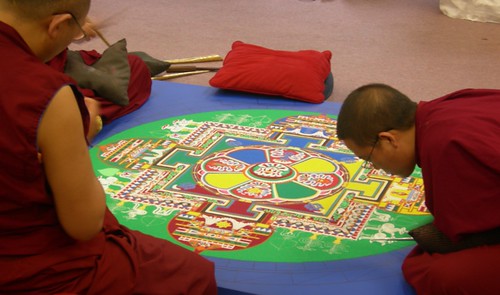
Xavier University Library is featuring Tibetan monks today creating a mandala. I'm going down to see it with the kids today. But thanks to the wonders of the Internet, you can view it via live webcam here.
Subscribe to:
Posts (Atom)